As you may know, Typhoon Hagupit/Ruby has been growing and weakening, threatening to wreak havoc on my new home in the Philippines. I left my home in Kananga, Leyte, Wednesday, November 26, and traveled to Tacloban, Leyte, where I stayed with my fellow YAV and awesome partner in this journey, Emily. On the morning of Thursday, November 27, we boarded a plane for Manila to celebrate Thanksgiving as a YAV community and to have our first retreat after two months at our site placements. Unfortunately, the weather had other plans for half of our group. Typhoon Queenie was coming through, causing choppy seas and heavy rains, which prevented our YAVs, Kendall and Tyler, and site coordinator, Cobbie, in Dumaguete from leaving on Thursday. Friday, November 28, we were all finally reunited for a time of relaxation and reflection.
Emily and I were supposed to fly back to Tacloban Wednesday, December 3. When we got to the airport around noon, our flight had been delayed about half an hour. No big deal. Then we got to the gate. The number of people at our gate was surprisingly high for over an hour before our flight was set to take off. Our departure time came and went. Our waiting game began. We learned that the 10:00 and 1:00 flight never left, and we could not get any information on our 3:00 flight. Emily and I knew that there is a typhoon brewing in the Pacific Ocean. At this point, we were unsure whether the storm would come to the Philippines, particularly the Visayas, where we live and hoped to return to, or if it would head north to Japan. We have seen evidence of the damage caused by Typhoon Yolanda just over a year ago on November 8, 2013. We have heard survivors share their stories of the trauma of living through the strongest storm to make landfall. As I heard a woman say in the airport, "I don't want to be a victim again."
We were scared. We did not know what to do. Why weren't flights leaving for Tacloban? Why wouldn't the airline give us any information? Was it safe to go back to Tacloban now? Would the evacuation centers be safe? What would happen? If we didn't go back now, what would we return to whenever we finally arrived in Leyte? How would this affect our jobs? Would we have to go home to the US? Was this God telling us not to go? We had so many unanswered questions.
By about 5:00, we were told that our flight was cancelled. We could retrieve our checked baggage and meet with a customer service representative to discuss our options. Emily and I agreed that we would reschedule our flight later when we knew more about the storm's trajectory. After walking all over the Ninoy Aquino International Airport, we had rebooked our flight for Friday, retrieved our baggage, and received a travel stipend. Our thought process was that we would know more about the storm by Friday and could return to Leyte if it was heading north. If it remained a threat, our flight would be cancelled, and we would rebook again.
It was a difficult decision. Before I came to the Philippines, I had resolved to stay with my community if something like this ever happened. I wanted to stay on the ground and be with my host family. I did not want to use my privilege to be evacuated or somehow remove myself from danger that my family could face. That decision is different when it's a choice not to return somewhere rather than a choice to leave. We were in Manila. We had options of places to stay. We felt more secure in the infrastructure in Manila than we did in Leyte. We would be better used in relief after the storm if we were healthy, rather than risk being injured in the storm. After many conversations with site coordinators and host families, we decided to wait out the storm in Manila.
After 8 hours in the airport, we made our way back to the National Council of Churches in the Philippines (NCCP) building in Quezon City, a city of Metro Manila, where we had spent our first few nights.
We woke up Thursday to the news that Typhoon Hagupit/Ruby had been upgraded to super typhoon status. We knew that we were not leaving Manila until the storm passed. Our waiting continued. We thought about our surroundings, checked to see if we were in a flood zone (we aren't), bought three days worth of food and water, called family and friends, and prayed. We checked for updates constantly. We talked way too much about potential scenarios and our reactions to those situations.
This was potentially the most terrifying situation of our lives. Realistically, I know we have probably been in more riskier places, but in all of those, we had some sort of control. We have no control over the weather or the buildings where we stay. We cannot just prepare and know it will be enough. Emily and I are both people who like control and need answers in our lives. This is definitely a time when we didn't have many answers or any control.
We watched the storm weaken down to a typhoon, only to strengthen back to a super typhoon right before it approached the East Visayas islands. This storm has moved agonizingly slow across the country. We waited and waited to hear of it making landfall in Samar, the island just north of Leyte. We heard of preventative power outages in Leyte and Samar and rain that lasted over 10 hours in my town of Kananga. Finally Friday night, Typhoon Hagupit/Ruby made landfall in Dolores, Samar, where, reportedly, 21 people have died. Power is still out in much of Leyte and Samar. There have been no reported casualties in Leyte. Some structures, including a room off of Emily's office, where her supervisor lives, are gone. My house and host family is fine. There has been little damage at my school, but nothing that would prevent us from having classes later this week.
We have tried to keep ourselves occupied by going to the malls nearby, which make Macy's in New York look like the Rock Hill Galleria mall. Every time we walk in, I feel completely overwhelmed as I try to process all the sights, sounds, lights, displays, and products, the epitome of materialism and consumerism. It feels like a totally different world compared to my home in Kananga.
Thankfully, Kelsey, our fellow YAV in Manila, lives close so we can share meals together to get out of our room a bit. We are trying not to get cabin fever, but it is difficult. Fortunately, we haven't completely tired of each other's company yet, after almost two full weeks of 24/7 companionship.
The storm is moving literally 10 mph across the Philippines, which also means it is weakening. Hagupit/Ruby is now only a tropical storm. We have been waiting for her to arrive in Manila for days. We thought rain would start Saturday night. We thought rain and wind would start Sunday evening or Monday early morning. Sunday was eerily calm with cooler temperatures and a pleasant breeze. Monday we awoke to no rain or wind still. A little bit of rain and wind has been on and off today, but nothing even remotely close to the flooding or 60 mph wind we've been preparing for and expecting. We are still waiting.
I guess it's rather appropriate that Emily and I would have this experience during the liturgical season of Advent. The literal meaning of the word advent is coming. We are waiting, preparing, expecting the birth of Jesus Christ, Our Lord and Savior. In the Philippines, we have been waiting, preparing, and expecting Typhoon Hagupit/Ruby. Jesus doesn't come to this world as a majestic king adorned in all vestments of royalty ready to take his place as ruler of the world. Jesus comes as a son to a carpenter and his wife, born in a lowly trough because there was no room for him in the inn. Jesus, the unexpected Messiah. Jesus, whose Gospel is so different from what it's listeners expect. Jesus, who calls us to do difficult things. Jesus, over whom we have no control. Jesus, whose coming we anxiously await and prepare for every single year.
This whole experience has been God teaching me a lesson on patience, trust, and prayer. My life is dependent upon God and God's Will. The lives of those I love are dependent upon God and God's Will. I am not in control. God is. It's way passed time for me to Let Go and Let God.
We truly appreciate all of the prayers and concern and support we have felt in the past week. In the aftermath of a similar storm, a wise woman once told me, "When you get to where God is all you have, you find that God is all you need."
Emily and I have a flight back to Tacloban on Wednesday afternoon, which we should be able to make with no weather obstacles.
I ask for continued prayers for me, my community, and everyone affected by Typhoon Hagupit/Ruby. Please give us the strength to provide relief, to continue to rebuild from both storms, to heal from trauma. For those whose lives and/or livelihoods are lost, we pray for assistance and guidance. We pray for all those providing relief, whether it comes from the government, non-government organizations, families, friends, entities overseas, churches, or communities. May the Grace and Peace of our Lord Jesus Christ be with you all.
I had the distinct pleasure of attending a seminar for guidance counselors and staff of private schools on Friday in Tacloban. The staff came from all over Samar and Leyte. Our morning sessions were filled with learning how guidance departments can best meet the needs of schools, students, teachers, administrators, and families in the 21st century. After lunch, we were asked to pick an object that symbolized our experiences when Supertyphoon Yolanda (Haiyan) struck the region just over a year ago on Friday, November 8, 2013, and that symbolizes where we are now. This exercise was called "Helping Professionals as Survivors of Disaster." As guidance staff, most of the professionals are focused on always helping others. This finally gave them the space to process and work on healing from the trauma of surviving a natural disaster.
I was so moved by the responses of these men and women. Their stories and words brought me to tears on multiple occasions. I had no right to be there, yet they welcomed me into that space and allowed me to hear their experiences of one of the most vulnerable and exposed times in their lives. We were asked to discuss what we heard, what we saw, and how we felt when Yolanda hit, as well as explain the symbolism of their object.
I have collected some of their words and have been given permission to share them with you. These words are direct quotes from survivors of Typhoon Yolanda, as best as I could record them. These words are portions of the remarks that spoke to me the most. Each line reflects a different person's words.
"Trying to be strong, trying to stand, trying to grow."
"Pray, cling to my Rosary, thankful for new life."
"Dancing coconut trees...I felt exposed as the roof blew off...Thirsty, no water."
"I felt guilty because others suffered worse."
"It is the most painful part for me, knowing that my kids suffered."
"95% of coconut trees in Kananga fell. 16 people died...Students killed by cinder blocks in the house."
"There is always hope. We must be strong because we have to move on."
"Yes, Yolanda destroyed everything on Earth, but Yolanda cannot destroy what is in me, the faith in the Lord."
"We prayed, and we moved our things. We prayed hard."
"We are united in prayer. God can take my life at any time."
"Words from a multi-cab driver, 'Why should we be afraid of the typhoon if we have faith in God?' Your life itself is a sign of hope, if only you believe."
"We were able to save 70 persons."
"Dead bodies."
"It feels like an earthquake. It's all white. I can't see anything. He opened the door. It was water. RUN! I can see people floating. Children crying. Help us. I was asking God, 'Will I survive this? Will I see my family again?' God, you still have a purpose for me. I see this as my second life.
"During that time I felt very small. Yolanda taught me I was just soil, clay. I was very small."
"We are a weed. We are uprooted by obstacles, but we always grow back."
"I felt the fear of dying. At the same time, I felt faith in God."
"If we have faith in God, nothing is impossible."
"I don't have the courage to see it [video footage she took during the storm]. I remember Job 1:21 'The Lord giveth and the Lord taketh away; praised be the Lord.'"
"I tied my children to my waist."
"Lord, your will be done. Lord, please help us. I saw my neighbors on the roof. The next second, they were gone...I am a coconut tree growing back. There is a greater force than Yolanda."
"I was not traumatized actually during that day...'Is it confirmed?' 'Yes.' 'Is he recognizable?' I found the keys to the house and car in his pocket.' I thought it was just my youngest brother, but it was the whole family that was washed out with the house...'Is it ok if what I put on the cart is a dead body?'"
"I realized something could happen, and I could be gone."
"I was helping the children that were crying."
"God is good! All the time! All the time! God is good!"
"I must be an inspiration to move on. There is still hope."
"I saw the destruction. I saw dead people. The Yolanda experience was destructive, but it brought the whole world together as one."
"When Typhoon Mario [September 2014] came, the fear I felt during Yolanda came back to me."
"I was the light of my family and my friends."
After processing, we all lit candles and watched this video. It is not perfect, but it put chills on my arms and tears in my eyes.
So, I ask you, where were you the morning of November 8? What did you hear? What did you see? What did you feel? While Yolanda was wreaking havoc on my new home, I was going to class, going to work, going to choir rehearsal, going to meetings, stressing out about homework and my capstone paper. I was going, going, going. I knew that it was possible for me to go to the Philippines, as I had just finished my application to the YAV program, but this event was not a huge issue in my life. It was but a blip on my radar. Now, this small country on the other side of the world is much bigger, and much more real. It is beautiful and so complex. It is a small, yellow flower, so beautiful, yet so small, that is blooming into a huge part of my life.
My chosen symbol of how I felt during Supertyphoon Yolanda and how I feel now pressed into my notebook
Before I get into the last installment of this series of posts, I want to give you a little personal life update. As of this week, I now have wifi access in both my home and school. I take this a sign from God that I should use this opportunity to continue in my seminary applications. My goal is to finish the applications by Thursday, November 27, Thanksgiving Day, and the beginning of our next YAV retreat. I am applying to Austin Presbyterian Theological Seminary, Columbia Theological Seminary, Louisville Presbyterian Theological Seminary, McCormick Theological Seminary, Pittsburgh Theological Seminary, Princeton Theological Seminary, San Francisco Theological Seminary, and Union Presbyterian Seminary. Yes, those are 8 of the 10 Presbyterian seminaries. I am excited to announce that I officially became an Inquirer Monday 7 pm EST/Tuesday 8 am UTC! The process of becoming an ordained minister in the Presbyterian Church begins with the Inquirer phase.
Now for my thoughts on 'MURICA, as they have developed so far in the Philippines.
"The America way of life" is simply not sustainable. Because it does not recognize there is a world beyond America. But fortunately, power has a shelf life. When the time comes, maybe this mighty empire will, like others before it, overreach itself and implode from within...Another world is not only possible, she's on her way. Maybe many of us won't be here to greet her, but on a quiet day, if I listen carefully, I can hear her breathing." -Arundhati Roy
I do not like to refer to my country of origin as "America." Like the bananas, this sentiment began in Nicaragua. It was my first time traveling around Central America. Our tour guides explained to us how exclusive it was that we, people from the United States of America, would call ourselves "American."
Hello!!! There are two whole continents and a region in the middle that we don't really know what to do with that have "America" in the name!! So many people in the US and around the world only refer to the US or its people when they say "America" or "Americans." When we say this, does it mean that someone from Perú, Nicaragua, Honduras, Mexico, Colombia, Brazil, Argentina, or any other number of countries is any less "American"? We specify North America, Central America, and South America when we refer to specific regions. Logically, when someone says America, wouldn't they be referring to someone from any of these regions because America is a more broad term? We all know that is not the case.
Let's get real. We tend to have a superiority complex about our country and our culture. The American Dream does not exist. I do not think that the US is the best country ever. Equal opportunity only exists for certain people. However, so much of our national identity depends on being the best, having the most, and showing it all off. I have been to countless parties and events focused on this idea of "America" where people, including myself, have worn the symbols of the great US of A on every article of clothing or accessory possible. It gets pretty ridiculous. There is a difference between national pride and throwing the stars and stripes in everyone's face. Other countries have red, white, and blue as their national colors, too, you know.
It is this dangerous mix of ignorance and arrogance that can get us in trouble. Throw in a bit of fear-mongering, and you've got a nice molotov cocktail set to explode into division and discrimination against anyone or anything that represents the "other." It is so outrageous that the US State Department's advisory for Worldwide Caution only addresses areas where extremist Muslims, the modern big bad wolf, are out to get people from the US. This is the fuel that leads to Islamophobia, prejudice, and discrimination against innocent Muslims and Arabs around the world. According to this report, the biggest threat around the world is terrorist attacks. Guess who is completely excluded in this report. North, Central, and South America. Yes, we know threats exist in those areas on some level, but it is not enough to warrant inclusion in the Worldwide report. This "worldwide" report excludes a huge chunk of the globe! If this is not an example of systemic discrimination, then I don't know what is! Not that I want South, Central, and North America to be regions where we should be afraid, but isn't that kind of messed up?
I am so angry. I am angry about the culture and attitudes in the US. I am angry about privilege and power in our country. I am angry that appearance dictates so much about power and privilege in our country. I am angry that equality does not exist in our country. I am angry about the way that our country is portrayed to and understood by other countries in the world. I am angry that US citizens are welcomed with open arms, homes, kitchens, hearts, and minds in the Philippines, yet we would never give them the same hospitable treatment in our country. I am angry that the US colonized this country and that it has not fully relinquished that power. I am angry that the Visiting Forces Agreement (VFA) is still in effect.
The Visiting Forces Agreement is what allows US military to maintain a presence in the Philippines with essentially no strings attached. It is this culture of superiority and power that contributed to the situation with a US marine who is accused of murdering a transgender Filipina woman on October 11, 2014. The VFA states that any military personnel accused of a crime on Philippine soil will be tried in the Philippine courts, but they can remain in US custody. We can discuss the systems involved in this case for days. Gender relations, LGBTQ, race relations, cultural differences, mental health issues, military issues, and power dynamics are only some of the systems at play. Many Filipin@s are calling for the end of the VFA, but President Aquino has clearly stated that the VFA will stand. The US still controls so much of this country's economy, culture, and politics. Even when the US colonial era ended in the Philippines, we still operated as a neocolonial power. The US government encouraged the oligarchical government to adopt neoliberal policies that disproportionately benefit those in power within and outside of the country and disproportionately harm the vast majority of Filipin@s.
The US has so much power, yet so many of its people still cower in fear. Fear from the systems of injustice that remain despite our years of "progress." Fear developed by the media and political campaigns in order to garner more power and support. Fear of the future. Fear of violence. Fear of job loss. Fear of no more food. Fear of no more money. Fear of illness. Fear of the unknown. Fear of death.
This fear and our culture of individualism and bigger, better everything is the fuel that powers the machine that is the US sense of competition. Do we think about how our bigger, better aspirations affect our neighbors, our brothers and sisters all over the world? Eh, maybe sometimes, we may consider it for a little bit.
"Here, I find it easy to live a life that constantly exploits people we have never met before, and I wanted to live with a sense of the rest of the world." -Ellie Roscher
This should not be news to anyone, but apparently some people still need convincing.
Climate change exists.
I always knew that, but I didn't really understand it until I came to the Philippines. It hit me in the face and still does every week. The Philippines is the country most vulnerable to climate change. Emily, a fellow YAV serving in Tacloban, Leyte, is working in environmental education. I have had the distinct privilege of listening to her presentation twice, and I am still learning much about climate change and environmental justice.
Saturday, November 8, 2014, is the one year anniversary of Supertyphoon Yolanda/Haiyan. One year ago, my community, Kananga, Leyte, along with communities all over the Visayas region, was absolutely devastated. Houses were destroyed. ~12,000 lives were lost. Crops were ruined. Fruit trees were toppled. Metal roofs were removed. Steel beams were twisted by the 170 mph winds. Freight boats crashed into the coast, and still rest where they landed. One year later, and we still have such a long way to go to recover.
One of the eight freight ships that were grounded inland during Supertyphoon Yolanda, destroying homes along the coast.
My only reference for comparison is Hurricane Katrina and D'Iberville, MS. August 29, 2005, Hurricane Katrina made landfall in D'Iberville. June 2008, we were able to come together to celebrate the end of recovery and rehabilitation. Members of my family went on five total mission trips to D'Iberville to do what we could to help them recover between 2005 and 2007. D'Iberville is a small town that was fortunate enough to have an awesome team of leaders and organizers who worked with relief and rehabilitation organizations. They created an efficient system and used volunteer groups to work with families to rebuild. It still took them almost three years.
One year later, relief is becoming rehabilitation in the Philippines. We know that Yolanda was not the last supertyphoon to come through. Unfortunately, most areas don't have the resources to effectively organize and work to rebuild together. Families are working to rebuild by giving smaller amounts of money to rebuild certain parts of homes or lots. Some people left because they did not have the resources to rebuild. D'Iberville's timely recovery was due to strong leadership and a smaller concentration area for rebuilding. This simply is not happening in the Philippines.
I did not realize the extent of the damage until we traveled south to Maasin last week. I saw covered courts and stages that looked structurally sound and secure. I saw forests full of healthy, fruit-bearing trees. Those do not exist in northern Leyte. What I had assumed was just a part of the life in Leyte have only been a part of life for one year.
Supertyphoon Yolanda ravaged this Samar beach, destroying tall trees that could serve as a barrier from strong storms.
Unless the world takes serious actions to mitigate climate change, it is going to be much worse. The Philippines' contributions to carbon emissions are minimal compared to many other countries. This country is on the receiving end of distributive injustices. Countries like the US, China, India, and Russia contribute more to carbon emissions, but countries like the Philippines experience the devastating impacts of climate change. Yes, Hurricane Katrina was a destructive natural disaster, but the US has more resources to rebuild faster and stronger than the Philippines can right now. The US also had more necessary plans and infrastructure already in place. So many people died in Supertyphoon Yolanda because they didn't understand what "storm surge" meant, which ravaged places like Tacloban. The people have learned through their pain and loss.
The fear here is that another Yolanda will come. The fear is that families will be forced to swim again, holding their children above the water while trying to keep themselves a float. The fear is that they will lose their boat, the only source of livelihood, again. The fear is that families will cower under a dining room table, praying that another section of the roof does not collapse on them again. The fear is that they will have to wade through waist-high mud to get to a food truck that got stuck on the way to the village again. The fear is that they will be trapped in a small concrete comfort room (bathroom) for 12 hours again. The fear is that they will walk through the streets and see the bodies of community members again.
Another YAV, Abby Evans, posted this video in one of her recent blogs. It is a beautiful, poignant description of distributive injustice. (One of the students dressed in the traditional dress of Marshall Islands for the recent United Nations Day celebration, which is one of the only reasons I knew that this country existed at all.)
Yeah, Angela, but what can I do about it while I'm just looking at my computer screen? Well, I'm a bit late because election day was Tuesday. Unfortunately, with the results of this midterm election, I do not think we will make much progress toward mitigating climate change in the next two years. Thank you, polarization and politics! (Another just peachy part of US culture.) Still, many organizations are working for climate justice. While you're looking at your computer screen, just Google it. Write letters to your representatives to let them know that this matters to you. Work for change. Let the government know you will not tolerate inaction anymore. Change your individual behaviors. Recycle! It's so easy, and we even have the infrastructure available to handle it! Be aware of your energy consumption. Do you drive your car when you could just as easily walk somewhere? Do you run the water longer than you need?
A few weeks ago, National Heroes Institute (NHI), my school, lead the mid-week prayer meeting at our church. My dear companion, Simon, an intern from United Evangelical Mission (UEM) in Germany, gave the message. At the heart of the message was the theme of Protestant Church Day in Germany in 2013, taken from Exodus 16:18: As much as you need. Only use as much as you need. God instructed the Israelites to take only as much as they needed for the day's food. God would provide food the next day. I urge you to think critically in considering what you truly "need." My understanding of that has definitely changed in the past two months, and I hope that these words encourage you to re-evaluate your own consumption of the resources of this beautiful earth.
At the end of the day, as much as it drives me crazy to be from the US, it is my home. We are not always proud of our homes; nonetheless, we are products of our homes. I am who I am today because of my experiences. I fully recognize my privilege as a citizen of the United States. I do not like the fact that my appearance and passport make life easier for me in so many parts of the world. I am thankful for the opportunities I have had to explore this world and learn in and outside of so many classrooms. I am thankful for the privilege that allows me to take this year to serve as a YAV in the Philippines. I am thankful for the opportunity to use this experience and my story to amplify the voices of this nation. I am thankful that my life has been forever changed by the past two months. And I am not sorry.
I know this has been a long post, but I want to leave with you with a few words that have helped to form these views over the past two months.
This is a selection from the UCCP hymnal, Hymnal of a Faith Journey, that we read during the NHI-lead mid-week prayer service that spoke to me and filled me, which helped to bring me out of a low point in this journey.
"Reverse Creation"
In the end, humanity destroyed the heaven that was called earth. The earth had been beautiful until the spirit of humanity moved over it and destroyed all things.
And the people said...
Let there be darkness...and there was darkness.
And the people liked the darkness; so they called the darkness "security."
And they divided themselves into race and religions and classes (and sexes) of society.
And there was no evening and no morning on the seventh day before the end.
And the people said...
Let there be a strong government to control us in our darkness.
Let there be armies to control our bodies, so that we may learn to kill one another neatly and efficiently in our darkness.
And there was no evening and no morning on the sixth day before the end.
And the people said...
Let there be rockets and bombs to kill faster and easier;
Let there be gas chambers and furnaces to be more thorough.
And there was no evening and no morning on the fifth day before the end.
And the people said...
Let there be drugs and other forms of escape for there is this constant annoyance...
which is disturbing our comfort.
And there was no evening and no morning on the fourth day before the end.
And the people said...
Let us create God in our image.
Let some other god compete with us.
Let us say that God thinks—as we think;
hates—as we hate;
and kills—as we kill.
And there was no evening and no morning on the second day before the end.
On the LAST day there was great noise on the face of the earth. Fire consumed the beautiful globe, and there was—SILENCE. The blackened earth now rested, to worship the one true God;
And God saw all that the people had done-and in the silence over the smoldering ruins—GOD WEPT.
Bernard Backman
Job 31:13-15
“If I have rejected the cause of my male or female slaves,
when they brought a complaint against me;
what then shall I do when God rises up?
When he makes inquiry, what shall I answer him?
Did not he who made me in the womb make them?
And did not one fashion us in the womb?
Psalm 9:20
Put them in fear, O Lord;
let the nations know that they are only human.
Psalm 10
Why, O Lord, do you stand far off?
Why do you hide yourself in times of trouble?
In arrogance the wicked persecute the poor—
let them be caught in the schemes they have devised.
For the wicked boast of the desires of their heart,
those greedy for gain curse and renounce the Lord.
In the pride of their countenance the wicked say, “God will not seek it out”;
all their thoughts are, “There is no God.”
Their ways prosper at all times;
your judgments are on high, out of their sight;
as for their foes, they scoff at them.
They think in their heart, “We shall not be moved;
throughout all generations we shall not meet adversity.”
Their mouths are filled with cursing and deceit and oppression;
under their tongues are mischief and iniquity.
They sit in ambush in the villages;
in hiding places they murder the innocent.
Their eyes stealthily watch for the helpless;
they lurk in secret like a lion in its covert;
they lurk that they may seize the poor;
they seize the poor and drag them off in their net.
They stoop, they crouch,
and the helpless fall by their might.
They think in their heart, “God has forgotten,
he has hidden his face, he will never see it.”
Rise up, O Lord; O God, lift up your hand;
do not forget the oppressed.
Why do the wicked renounce God,
and say in their hearts, “You will not call us to account”?
But you do see! Indeed you note trouble and grief,
that you may take it into your hands;
the helpless commit themselves to you;
you have been the helper of the orphan.
Break the arm of the wicked and evildoers;
seek out their wickedness until you find none.
The Lord is king forever and ever;
the nations shall perish from his land.
O Lord, you will hear the desire of the meek;
you will strengthen their heart, you will incline your ear
to do justice for the orphan and the oppressed,
so that those from earth may strike terror no more.
"Now that I have returned to a country where my race, class, and language give me the advantage, I still cannot fathom what it is like to struggle daily on the outside of privilege for a lifetime." -Ellie Roscher
"While living for a few months in one of the 'young towns' surrounding Lima, Perú, I first heard the term 'reverse mission.' I had come from the North to the South to help the poor; but the longer I was among the poor the more I became aware that there was another mission, the mission from the South to the North. When I returned to the North, I was deeply convinced that my main task would be to help the poor of Latin America convert their wealthy brothers and sisters in the United States and Canada...This 'reversal' is the sign of God's Spirit. The poor have a mission to the rich, the blacks have a mission to the whites, the handicapped have a mission to the 'normal,' the gay people have a mission to the straight, the dying have a mission to the living. Those whom the world has made into victims God has chosen to be bearers of good news." -Henri Nouwen
As promised, this is the second installment of a three part blog series on Reactions Against the Empire. So what’s this thing about bananas? They have lots of potassium. They taste delicious. They can go in so many different dishes. Have you ever thought about where your bananas (or any other food) come from? Have you ever thought about the people who help your bananas get to your grocery store or local market? I started thinking about bananas winter term 2012 before I went to Nicaragua for a month with my one and only business class. I learned about the plight of the banana workers who worked for Dole and experienced significant health effects from working in unsafe conditions with dangerous chemicals. Two and a half years later, I came to the Philippines and spent some time in banana plantations in Compostela on our first immersion. While we were living with and seeing the plantations and processing plants, I could not help but see the striking similarities to the situation in Nicaragua. However, in Nicaragua, Dole had to pay damages to a group of workers who filed and won a lawsuit in California courts. In the Philippines, the issue is a bit different. The plantations are still very much operating. The workers are organizing into unions in order to collectively bargain for high wages and better working conditions. We talked primarily with the leaders and workers at Sumifru plantations and processing plants. It is necessary to give a bit of background to the banana industry in this region before we continue. Families own the land where the plantations are located. Multinational companies sign contracts with the landowners where they rent the land for periods of about fifteen years, after which the companies pull out and move to other plots of land. After fifteen years of aggressive planting, fertilizing, spreading pesticides, harvesting, and repeating the process with only one crop, the once fertile ground has lost all of its nutrients. The company is out of the contract, and the family has land that needs to recover before growing any more crops. The farming process relies mainly on manual labor. Runners go throughout the fields so that fertilizer and pesticides can reach the banana trees. Employees on the plantations work sometimes 10-12 hours a day for only ~PhP100 (~USD$2.50) per day. Let me remind you that PhP52/day (~USD$1) is the poverty line. Minimum wage is supposed to be PhP300/day (~USD$7), but you still cannot feed a family of six with that salary. Employees in the processing plant earn PhP125/day (~USD$2.80), but that was only after much fighting against the companies. When it comes to the processing plants, the pay is a bit better, but the situations are not. The employees receive only a one hour break for a meal and one 15 minute break for an entire 8 hour shift on their feet. Bathroom breaks are regulated and do not happen very often.
An employee using his body weight to pull 6 50kg bags of limestone on a runner to the banana trees
Most of the employees live in or near to the plantations. Nearly every day, companies are doing aerial fertilizer sprays over the plantations, as well as the homes of the community. We were not allowed to leave our host’s house because we had to wait for the chemicals to settle. These sometimes-unannounced sprays trap people in their own homes or expose them to chemicals that are dangerous to the skin and body.
Fresh banana stalks from the field ready to be processed
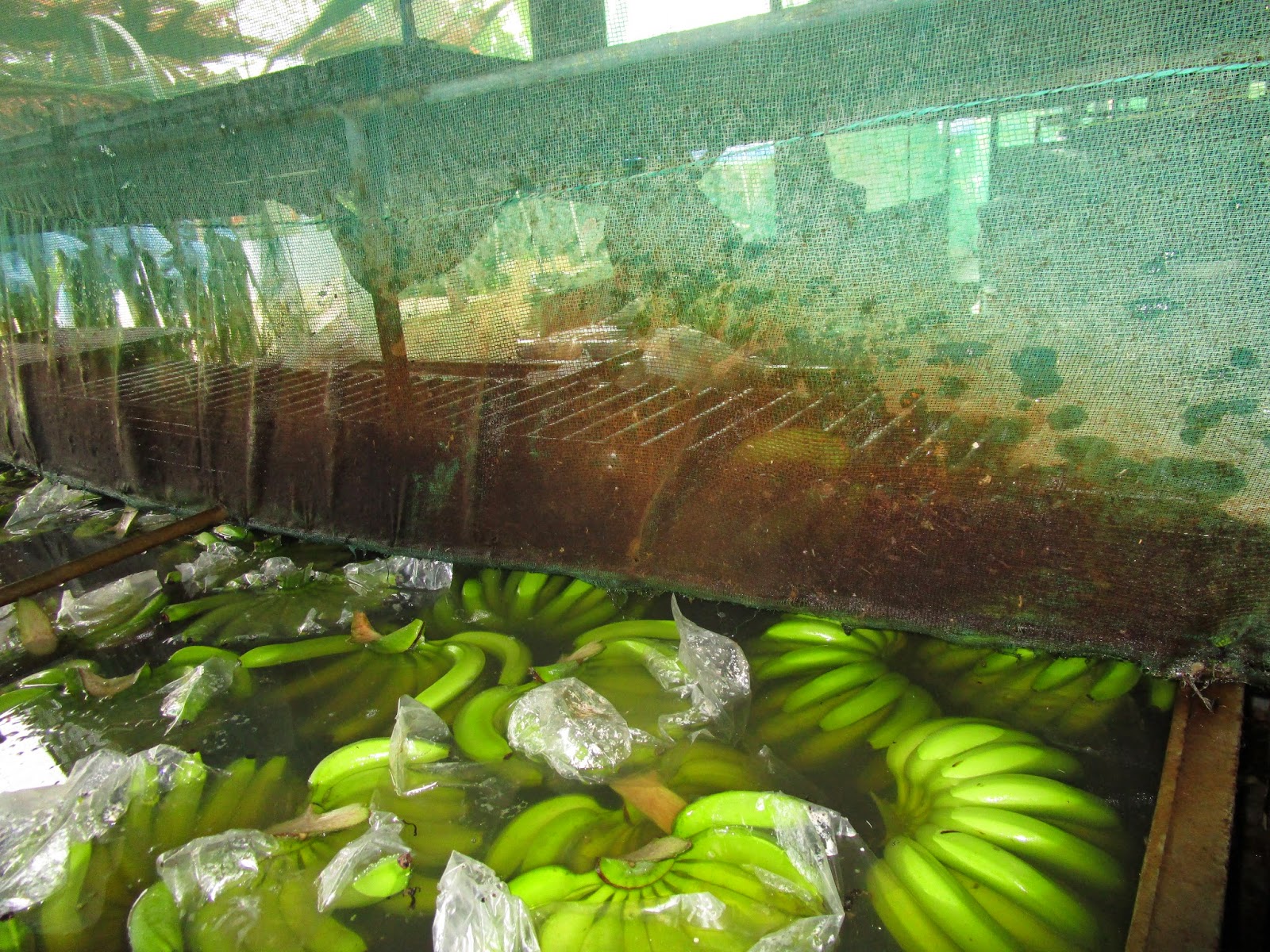
For the actual processing, the banana stalks are cut and brought to the plant when the bananas are still very green and almost impossible to eat. They are washed, and the “rejects” are separated out. Even though the rejected fruits will not be sold on supermarket shelves, employees still have to pay to take some of these “substandard quality” bananas home.
The bananas that do not pass the standards of quality for exportation but are valuable enough to charge employees for them
During the washing, processing, and packaging, the bananas are covered in chemicals. As we walked past the plant, I had to cover my face to try to stifle the strong smell of chlorine coming from inside. This was worse than when I have put pure tablets of chlorine into a swimming pool pump system. Your food is drowning in that chemical. Yes, you peel bananas, but you are still touching the part that has been exposed to so many chemicals.
The washing station where the bananas first go after they are cut from the stalk
I had to take this picture through the net window, but I could still smell and feel the strength of the chlorine in this solution.
When the bananas leave the plant, they have already been packaged in bags and then boxes, ready to be exported to countries like China, New Zealand, and the US. Who knows how long it actually takes for the bananas to appear in your produce aisle? Don’t you think your bananas would taste a lot better if they were picked a few weeks later when they were actually close to being ripe? Do you really want to ingest all of the chemicals that your bunch of bananas has been exposed to from pesticides to fertilizers to the “cleaning” chlorine? What is the point of this whole process??? To harvest and sell as many bananas as quickly as possible to earn the most money possible. Who does this money benefit? It is definitely not benefitting the workers on the ground in Nicaragua or the Philippines. It doesn’t even benefit the Philippine government or national budget, as most of these companies benefit from tax exemption thanks to US-supported neoliberal policies. Ok, well now what? I would love to tell you to boycott the bananas from large multinational corporations. That’s an easy answer. I would love to tell you to only buy local and shop local only (a statement I’m sure my dad is happy to read). However, reality is more complicated than that. If we launch a boycotting campaign against all big food business (because I’m sure that this does not only happen in the banana industry or only outside of the US), then we would really end up hurting the people we most want to help. Sure, the stocks of multinational companies would feel a little bit of the effects, but the corporate level executives will probably not go into poverty because of a boycott. It is the people on the ground working in the fields and processing plants who would hurt most. They would lose the little job they had. As many of the workers told us, even a little money is better than no money. It would cost at least a generation of employees their jobs and livelihoods before any real change in corporate ethics would take place. It’s not like Compostela is bursting with other jobs for its people. So what do we do? I cannot give you a succinct, articulate, straightforward answer. What I can do is tell you that my eyes have been opened, and I refuse to close them again. I am trying to be a more conscious and intentional shopper while I am in the Philippine. I intend to continue to do this when I return to the US. That is still so difficult. I am still complicit in the Empire when I buy my NesCafé packets of instant coffee. Nestlé is not my favorite company. The Empire has dominated the markets so much that there are no options of locally and justly grown and produced foods in grocery stores or supermarkets. I only have any sense of where foods come from if I can find them in the local market. I especially feel for my national YAVs who are living on food budgets that seem tighter than mine. How can you live out food justice on a simple living budget? Healthy and just food is more expensive than processed imports because of the higher production costs involved. I guess when you commit yourself to that ideal, you must make hard decisions distinguishing needs from wants. However, a family living with a tight budget may not be able to afford to live out that pledge, no matter how strongly they believe in the concept. It’s a hard issue that does not come with an easy answer. I urge you to look at what is in your kitchen, pantry, refrigerator, and freezer. Think about these issues. Think about the hands that helped to bring the food to you, from the field, to the processing plant, to the transportation, to the stocker at the store, to the cashier. Think of these people who all have valid names, faces, and stories, just as complex as yours.
I have been working on this blog post in my head and journal
since my first week or so in the Philippines. The 6 weeks since then have
challenged my original reflections and beliefs. My experiences continue to shape these initial reactions, and they are definitely not settled yet. I plan to explain these thoughts in a
series of three posts: Development, Bananas, and ‘MURICA!! Each of these posts deals with the environment and US influences on the situations I’ve encountered
so far. I have been so impressed by how close to the land and
environment is to every person we have met in our travels and experiences.
Students from schools and communities have performed numerous dances and
original songs dedicated to climate justice. Nearly every Sunday, I have prayed
in church about humanity’s sinfulness contributing to environmental problems. The
following prayer is the Prayer of Confession from Silliman United Church of Christ in the Philippines (UCCP) Church in
Dumaguete from Sunday, September 28:
Merciful God, in your gracious presence we confess our sin
and the sin of this world. Although Christ is risen from the grave and has
shattered the power of death, we are still held captive by fear and doubt. We
hold on to suspicions and jealousies that set neighbor against neighbor and
nation against nation. We have neglected the poor and the hungry. In our
pursuit of the “good life” we have gone along with injustice; we have ignored
the cries of the oppressed. We pursue profits and pleasures that harm the land
and pollute the waters. We have squandered the Earth’s gifts on technologies of
destruction. Have mercy on us, O God. Help us to trust your power to change our
lives and make us new, that we, and all your creatures, may know the joy of
life abundant, given through Jesus Christ, the risen Lord. Amen.
Silliman Church, Dumaguete
It is with this context that I come to my first fairly
radical change of stance on development. This idea blossomed as I rode on the
back of a “skylab” (covered motorcycle) two hours up and then down the
mountains of Compostela Valley Province heading to and from the community of
Indigenous People (IP) in Panansalan. This was our very first immersion and
opportunity to do life with a community of Filipin@s. It is quite fitting that I am writing this during UCCP's Indigenous Peoples Month, which also happens to overlap with Columbus Day in the US.
Rachel, Simon, Nils, and their driver squished on a skylab
Sometimes the roads were paved, often with many cracks or
still under construction. Sometimes the roads were packed down rocks. Sometimes
the roads were simply mud. There were few guardrails. If we fell or
slipped, there would be no help to get us. It would take too long for any sort
of rescue team or vehicle to get to us to take us to a hospital. That being
said, it was still a beautiful and clarifying ride. The motorcycles were able
to navigate most of the rocks and mud without too much of a problem, besides the occasional push or walk.
The roads that were paved were built by logging companies
that completely deforested the mountains home to many indigenous populations. The
companies financed the construction of the roads so that their equipment and
trucks could easily navigate the terrain. After they took all of the trees and
wore down the roads, the companies pulled out, leaving the local communities with
roads in a terrible state and a damaged ecosystem. The trees grew for
centuries. They held the fertile soil in place and provided a barrier for bad
weather. Now, the mountains are still green, but the plants are mainly low
brush with few tall trees that give the landscape a jagged look. The trees' root systems cannot protect against strong storms or landslides anymore.
The jagged treeline of the mountain and a particularly muddy part of the road
The Westerner in me wants to have a nicely paved road so
that everyone can travel between communities with ease and in a more timely
fashion, both for convenience and emergency situations. Perhaps the IP communities could sell their crops in the markets in
Compostela to earn some money, rather than relying on subsistence farming to
survive.
Then, I thought about the consequences of this
“development.” It would take so much time, energy, and effort to fully pave all
of these mountain roads. Those are resources that the government either does
not have or is not willing to designate to such a purpose. In that
construction, though, they must change the landscape, which would increase the
chances and occurrences of landslides. The construction waste would contaminate
an otherwise clean mountain stream. All of the equipment is dangerous for the motorcycles
trying to cross the mountains and would lead to more accidents, not to mention the hassle of construction. By the time the
roads were all paved, it would be time to do repairs on the first sections of
road. In the end is it really worth it?
Yes, dirt roads still exist in the US. Yes, many roads are
littered with potholes and are far overdue for repair and repaving. However, I
have never experienced anything quite so vulnerable as the roads to Panansalan.
I learned so much about living abundantly with so few material things from
this IP community. Life was good in its self-contained simplicity. The children
cooked, cleaned, farmed, and gathered spring water for themselves. They played
games together. They probably didn’t care about the state of the roads leading
to their community.
They did care about the land, though. The land that they
worked with their simply farming tools. The land that the government is gradually selling out from under them to mining companies eager to get the coal, gold, nickel,
copper, and iron resting under the tall, jagged peaks. The land that is called ancestral lands, meaning that it does not require any titles or deeds for ownership. They care about the
environment and how climate change has affected their land. Climate change, combined with the lack of tall, strong trees due to over-logging, has led to
disastrous storms and landslides, as shown through Typhoon Pablo in 2012. This is
the same climate change that developed nations (the US) contribute to in
disproportionate amounts. In the US, we experience some of the negative
consequences of our impact on the environment, but not to the extent as it is
felt in the Philippines and other developing countries. The infrastructure
needed to handle the bigger, faster, and stronger storms simply does not exist
in most, if not all, of this country.
May May, one of the students, weeding with a simple blade
So, I ask, what net good will truly come from building roads
in the mountains of Compostela Valley? If the only way to build roads is for a
multinational company to finance them before exploiting the resources in the
mountains, how will that benefit the people who call the mountains home? Is it
just another case of trying to make “them” more like “us”? Is that what
international development really is at the end of the day? In my experience,
international development has such a positive connotation. It is empowering the
lives of people by giving them more freedoms, capabilities, and opportunities
to make choices. I am conflicted, though. Developed countries give so much in
resources to developing countries in order to make them developed, to allow
them to compete in the global economy. However, at the most basic level, does
this not sound like we, the developed countries, are trying to make “them” more
like “us”? What would we lose of the IP community’s tribal culture if it became
a “developed” region? Who are we to say that “development” is what this
community needs the most? Must the road to "development" be paved to give the IP community the best opportunity to do life? What even counts as the "best opportunity"? Who decides those standards? Does the IP community have a say in their own standards of living? Who knows?
These ideas are not fully fleshed out, obviously, and I
welcome any respectful feedback. This idea has been challenged as I have
traveled 16 hours quite uncomfortably by car on poorly paved roads damaged by
Typhoon Yolanda. Perhaps this is too radical of an idea, but it is simply what
has been floating around in my head these past 6 weeks. I look forward to fleshing out more ideas like this in the next two posts of the series: Bananas and 'MURICA!!